As web developers, we've all been there.
A client asks for a small feature:
- "Can we add user roles?"
- "Can we restrict access to certain pages?"
- "Can we create a custom dashboard?"
- "Can users have different permissions?"
In WordPress, the answer often becomes:
"Sure, let's install another plugin."
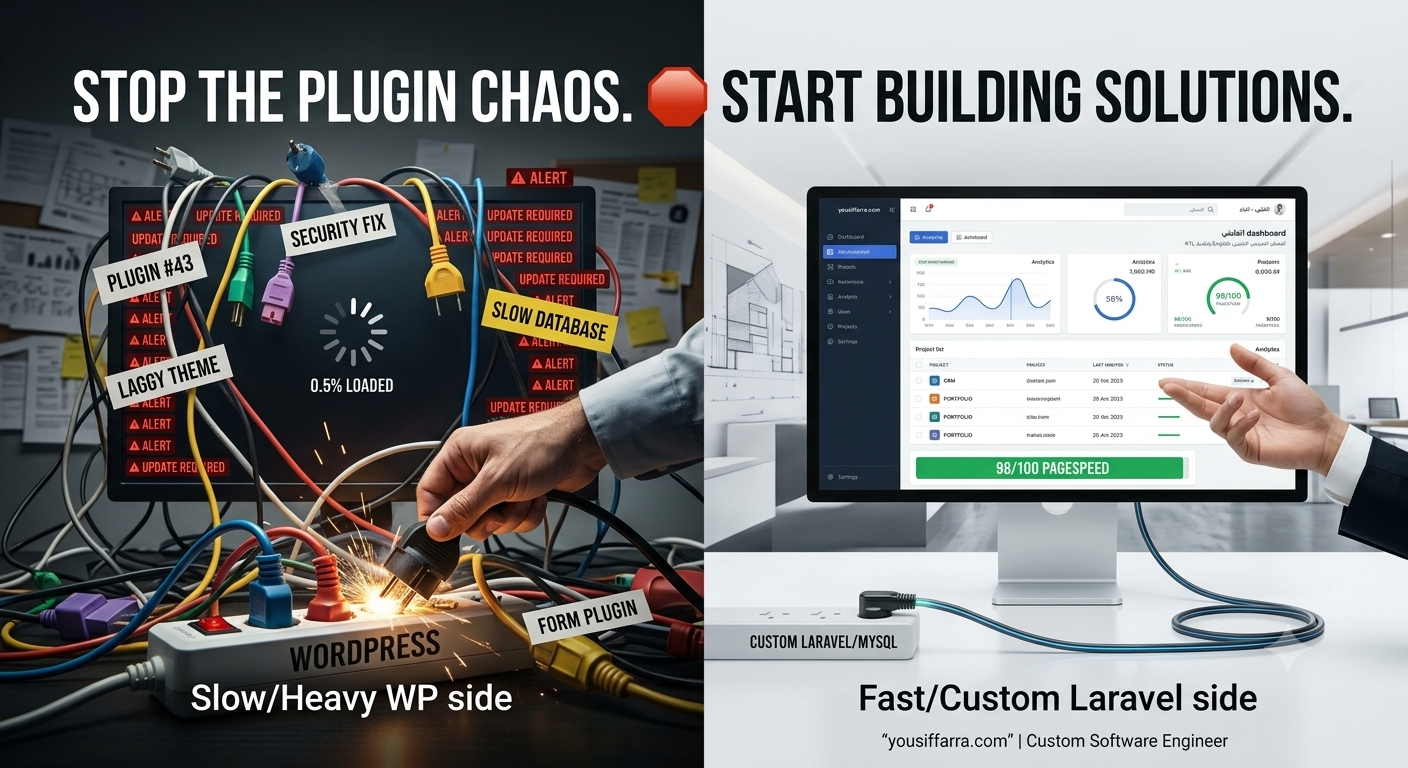
One plugin becomes five.
Five become fifteen.
Before long, your application depends on dozens of third-party packages just to provide features that should have been part of the architecture from the beginning.
This is where modern frameworks like Laravel completely change the game.
The Plugin TrapWordPress has earned its reputation because it's incredibly easy to get started.
Need SEO?
Install a plugin.
Need security?
Install another plugin.
Need user permissions?
Another plugin.
Need forms?
Another plugin.
Need custom fields?
Yet another plugin.
At first, this seems productive.
Instead of writing code, you're simply clicking "Install."
But as projects grow, every plugin introduces another dependency.
Every dependency introduces another update cycle.
Every update introduces another possible conflict.
Eventually, maintaining the application becomes harder than building it.
Instead of shipping new features, developers spend their time making sure Plugin A still works with Plugin B after yesterday's update.
That isn't development.
That's maintenance.
Technical Debt Grows QuietlyTechnical debt rarely appears overnight.
It accumulates one shortcut at a time.
The first plugin feels harmless.
The tenth plugin feels necessary.
The twentieth plugin becomes impossible to replace.
The result?
- Larger databases
- Slower queries
- More HTTP requests
- More JavaScript
- More CSS
- More security vulnerabilities
- Longer deployment times
- Difficult debugging
When a production issue appears, finding its source becomes incredibly difficult because your application is no longer just your code.
It's your code plus dozens of third-party packages written by dozens of different developers.
Laravel Starts From a Different PhilosophyLaravel approaches software from an entirely different perspective.
Instead of asking:
"Which plugin should I install?"
Laravel asks:
"How should this feature be designed?"
That difference is enormous.
Laravel already provides the building blocks needed for most business applications.
Instead of relying on external packages, you compose features using native framework components.
Examples include:
- Authentication
- Authorization
- Middleware
- Policies
- Gates
- Validation
- Queues
- Events
- Notifications
- Rate limiting
- Database migrations
- Caching
- API resources
These aren't afterthoughts.
They're part of the framework itself.
User Roles Don't Need a Huge PackageOne of the biggest misconceptions among Laravel developers is that every project needs a large permissions package.
In reality, many applications don't.
If your business only has:
- Admin
- Manager
- Employee
- Customer
You probably don't need thousands of lines of package code.
A simple middleware combined with Laravel Policies often provides everything required.
Instead of loading complex permission systems designed for every possible use case, you build exactly what your business needs.
Nothing more.
Nothing less.
This keeps your application:
- Smaller
- Faster
- Easier to understand
Some developers assume that custom development means writing thousands of extra lines of code.
Ironically, it's often the opposite.
A custom authorization layer may only require a handful of classes.
Because you understand every line of code, future changes become significantly easier.
Need another role?
Add it.
Need another permission?
Implement it.
Need business-specific logic?
Write it exactly as required.
No fighting package limitations.
No waiting for maintainers.
No hacks.
The TALL Stack Keeps Things LeanOne of my favorite approaches for modern business applications is the TALL Stack:
- Tailwind CSS
- Alpine.js
- Laravel
- Livewire
This combination allows developers to build highly interactive applications without introducing unnecessary frontend complexity.
Instead of managing large JavaScript frameworks for simple interactions, Livewire handles communication between the frontend and backend while keeping everything inside Laravel.
The result is a cleaner architecture with fewer moving parts.
Your business logic stays where it belongs.
Inside your Laravel application.
Performance Starts With ArchitectureMany developers focus on optimization too late.
They optimize images.
Compress CSS.
Minify JavaScript.
Enable caching.
While those improvements matter, they don't fix poor architecture.
Performance starts with design.
When your application depends on dozens of plugins, every request has additional work to perform.
Extra service providers.
Extra middleware.
Extra database queries.
Extra event listeners.
Extra assets.
Laravel allows you to control exactly what gets executed during every request.
Nothing runs unless you build it.
That level of control translates directly into better performance.
Security Improves When Dependencies DecreaseEvery external package increases your attack surface.
Even well-maintained packages can contain vulnerabilities.
If your application relies on dozens of third-party plugins, you're trusting every maintainer to keep their code secure and updated.
Reducing unnecessary dependencies naturally reduces risk.
Fewer packages mean:
- Fewer updates
- Fewer compatibility issues
- Fewer security advisories
- Easier auditing
- Better long-term stability
Software isn't finished when it's deployed.
That's when the real work begins.
Applications evolve.
Businesses change.
Requirements grow.
When the codebase is simple and well-structured, future development becomes much easier.
New developers understand the project faster.
Bug fixes become quicker.
Features become cheaper to build.
Maintenance becomes predictable.
Good architecture pays dividends for years.
Build Features, Not WorkaroundsOne of the biggest advantages of Laravel is that it encourages developers to think in terms of architecture instead of shortcuts.
Rather than searching for another package, ask yourself:
- Can this be solved with Middleware?
- Should this be handled by a Policy?
- Does this belong in a Service class?
- Would an Event make more sense?
- Can this be modeled directly in the domain?
More often than not, the answer is yes.
The result is software that's easier to understand, easier to maintain, and easier to scale.
Final ThoughtsWordPress remains an excellent solution for content-driven websites, blogs, and many small business projects. It has an enormous ecosystem and can deliver value quickly when used for the right purpose.
However, when you're building custom business platforms, CRMs, internal dashboards, SaaS products, or applications with unique workflows, relying on an ever-growing collection of plugins can introduce unnecessary complexity and technical debt.
Laravel offers a different path—one where you build with intention, leverage native framework features, and keep your codebase focused on your business requirements rather than third-party dependencies.
The goal isn't to avoid packages entirely. Great packages can save time and solve complex problems well. The goal is to use them thoughtfully, only when they provide real value that outweighs the cost of another dependency.
In the end, successful software isn't measured by how many packages it uses. It's measured by how maintainable, performant, secure, and adaptable it remains as the business grows.
Build clean. Build intentionally. Ship features—not technical debt.