If you run a mid-size security firm in the UK, you’ve probably been sold the same story more than once:
- Pay monthly.
- Log in.
- Hope the platform still fits how your sites actually run next year.
That model works for some companies.
For others, it quietly becomes expensive rent on a system they don’t control.
This post is about that choice: own vs rent — specifically for control-room / guard ops software.
What “renting” usually looks like
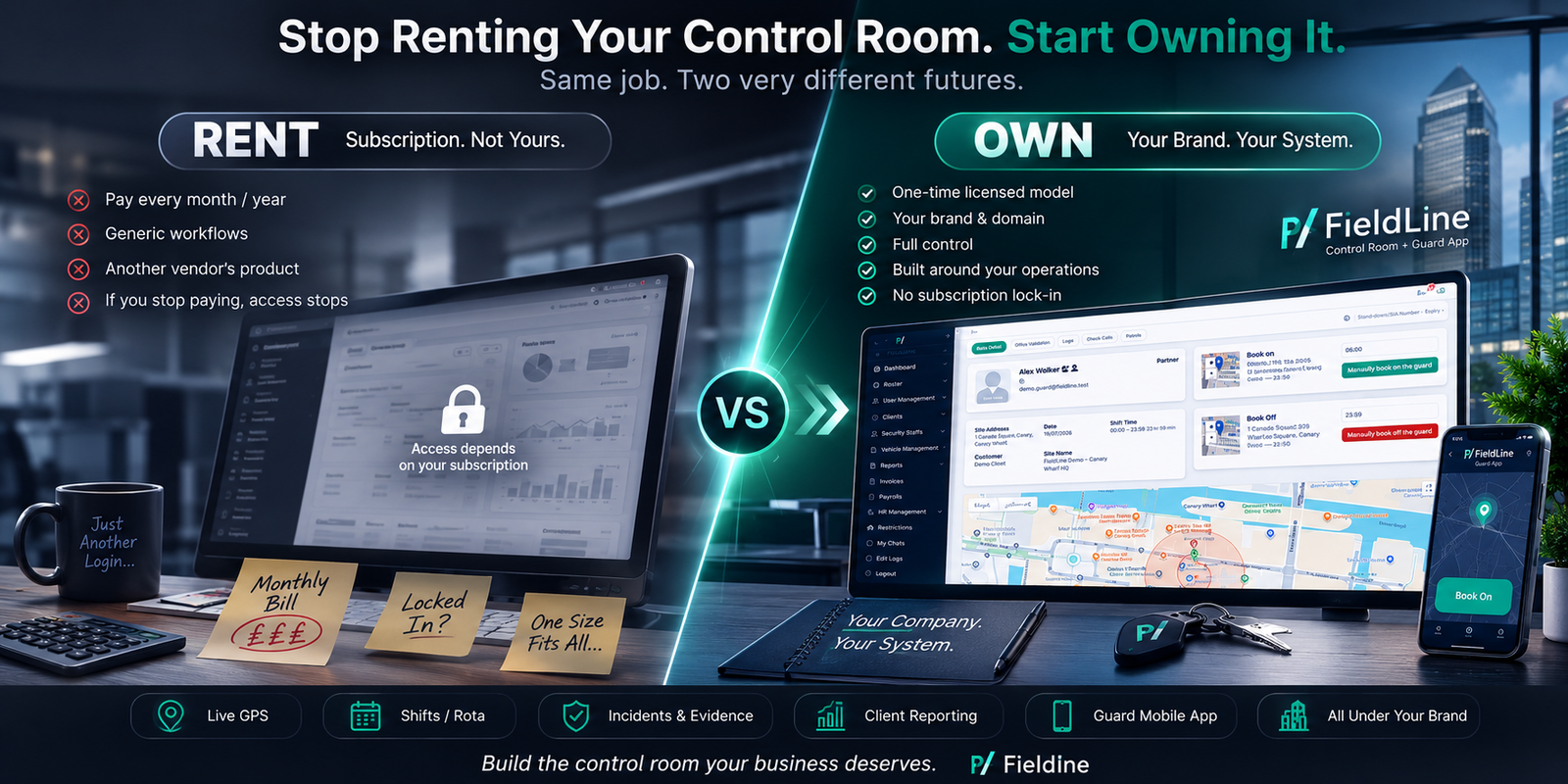
Most modern guard-management platforms are subscription SaaS.
In practice that often means:
- You pay every month or year for seats / modules
- Your team works inside someone else’s product
- Branding, workflows, and roadmap priorities belong to the vendor
- If you stop paying, access to the platform stops with it
That can be fine when:
- You want speed and low upfront commitment
- You’re happy being a tenant in a shared product
- Your process fits the vendor’s way of working
It gets uncomfortable when:
- You’re an owner-led firm that cares about brand and independence
- You’ve outgrown generic workflows
- You’re paying serious money every year and still feel locked in
- You want software that feels like part of your company, not a rented login
What “owning” can mean
Owning doesn’t have to mean building a custom system from zero (though some firms do that).
In practical terms, ownership usually means some mix of:
- Running software under your brand and domain
- Having a deployed copy you control
- Not losing the whole operational system the day a subscription ends
- Being able to shape the product around your process, not the other way around
The tradeoff is real too:
- Higher upfront cost than a cheap monthly plan
- You need someone responsible for hosting / updates / support decisions
- It’s a bigger commitment than “try a tool for 30 days”
So this isn’t a moral argument against SaaS.
It’s a fit argument.
The WhatsApp problem underneath the software debate
Before firms even argue SaaS vs owned software, many are still here:
- Rota conversations in WhatsApp groups
- Incident details scattered across chats, photos, and memory
- Patrol proof that is hard to pull together cleanly for a client
- Supervisors spending half the shift chasing updates instead of running the board
At that stage, the first upgrade isn’t “buy the most famous platform.”
The first upgrade is: get one operational source of truth.
A proper control room setup usually needs:
- Live visibility for who’s on which site
- Shift / rota that ops can trust
- Incident / DOB records with timestamps and evidence
- Client-ready reporting
- A guard app for book on/off, patrols, check-calls, and alerts
Whether you rent or own that stack, the goal is the same: less chaos, cleaner client delivery, tighter ops.
Who should keep renting
Renting is often the smarter move if:
- You’re small and still validating process
- Cashflow matters more than ownership right now
- You’re okay adapting your workflow to a standard product
- You don’t want responsibility for hosting or long-term maintenance
There’s no prize for owning software you won’t maintain.
Who should seriously consider owning
Ownership becomes more interesting when:
- You’re mid-size (roughly tens of guards, multi-site work)
- Client reporting and brand presentation matter
- You’re tired of annual platform bills for a system you don’t control
- You want white-label: your logo, your domain, your system identity
- You have (or can appoint) someone to own the operational rollout
This is exactly the gap FieldLine was built for.
FieldLine is a white-label control room + guard app for manned guarding / multi-site security ops:
- Live GPS for the control room
- Shifts / rota
- Incidents with evidence
- Client portal and exports
- Guard mobile workflows
One-time licensed model. Your brand. Your deployment path. Built so firms can run the system as theirs — not just rent another login forever.
If you want the walkthrough: https://fieldline-wf.com
A simple decision test
Ask yourself four questions:
- If we stopped paying for our current tool tomorrow, what would we still control?
- Does our ops process fit the software — or are we constantly working around it?
- Are we paying for convenience, or paying because we never chose another path?
- Do we care more about low monthly commitment, or long-term ownership and brand?
If your answers lean toward control, brand, and multi-year independence, ownership deserves a real look.
If your answers lean toward flexibility and speed with less responsibility, renting may still be right.
Final thought
The market loves framing this as “modern SaaS vs old-fashioned systems.”
That’s the wrong frame.
The real question for a UK guarding firm is simpler:
Do you want to keep renting your control room every year — or eventually run one that feels like part of your company?
Neither answer is automatically correct.
But if you’re mid-size, multi-site, and tired of paying forever for a platform you don’t own, it’s a question worth answering deliberately.